[CPI Cultural Trend] Series #1 Day in the life of an Archaeologist
CPI Cultural Trend is the article from CPI participants who were selected as the 2020 CPI Reporter. They deliver main issues and trends of Arts & Culture industry in their country of their field four times a year. In this volume, a basic overview of their field and a work they do have been published.
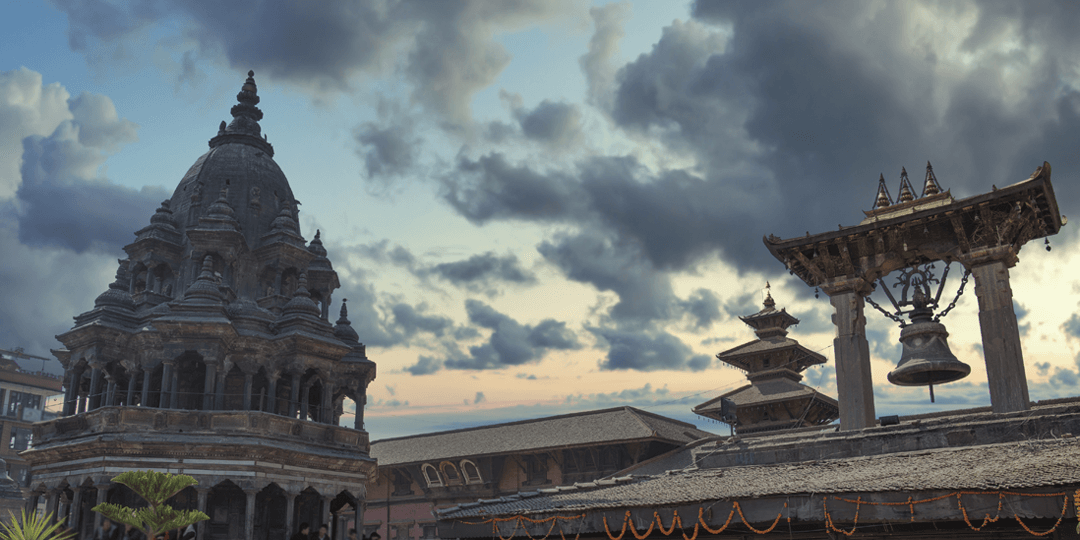
Nepalese culture is a tradition adopted for thousands of years by people of more than 123 tribes speaking more than 102 languages. Nepalese culture passing through different epochs in history since its inception has reached to its present state by continuous transformation. The cultural practice of any nation is influenced by the political revolution experienced by that nation. The Nepalese social system was established and managed by the monarchs in the beginning and so the culture also developed accordingly. The recent abrupt change in the old political system has brought a remarkable deviation in Nepalese culture, especially in intangible aspects. Now, since the old culture has gradually been abandoned but new culture has not been developed and adopted completely, Nepalese culture is going through a transitional phase in some extent.
This article basically focuses on the tangible cultural aspect, emphasizing on the role of the Department of Archaeology (DoA), where this scribe is employed as an archaeological officer.
Department of Archaeology
Acknowledging the importance of rich Nepalese culture, the DoA was established in 1953 AD under the Government of Nepal. This is the soul organization for the archaeological research and protection of the cultural heritage of the country. It regulates all activities as per the provision of the ‘Ancient Monument Preservation Act, 1956 which authorizes the Department as a principal government authority to protect, preserve and manage the archaeology throughout the country.
The Legal system and the supremacy of
the Department of Archaeology
There used to be, in the past, a traditional trust for each of the public monument and such trusts were responsible for all kinds of conservation and management of those monuments or sites. However, in present context, the Guthi focuses more on the intangible aspects and the DoA looks after the tangible part of the culture. There are legal tools to manage all the heritage issues. Ancient Monument Preservation Act, 1956, Ancient Monument Preservation Rule, 1989, Ancient Moment conservation Bylaw, 2008, Basic Guidelines for the Conservation and Reconstruction of Earthquake damaged Heritage, 2015, Manual for the Conservation and Reconstruction of Earthquake damaged Heritage, 2016, and Cultural Policy of Nepal etc. are the various legislative tools to guide the heritage issues.
Major assignments of Department
of Archaeology
The Department of Archaeology, being a supreme authority for all the cultural heritage issues in Nepal, is assigned for the responsibilities such as preservation and protection of monuments and archaeological sites, archaeological exploration, excavation and report publication. Moreover, the Department also establishes and enhances the museums, protects, preserves and manages the World Cultural Heritage Sites, prepares and publishes the inventory of the cultural heritage, controls the illicit export and import of the movable cultural properties.
Presently, after the earthquake, employees of the Department are concentrated on the works related to rehabilitation of the damaged heritages; however, research and field archaeology are also on going in lesser extent.
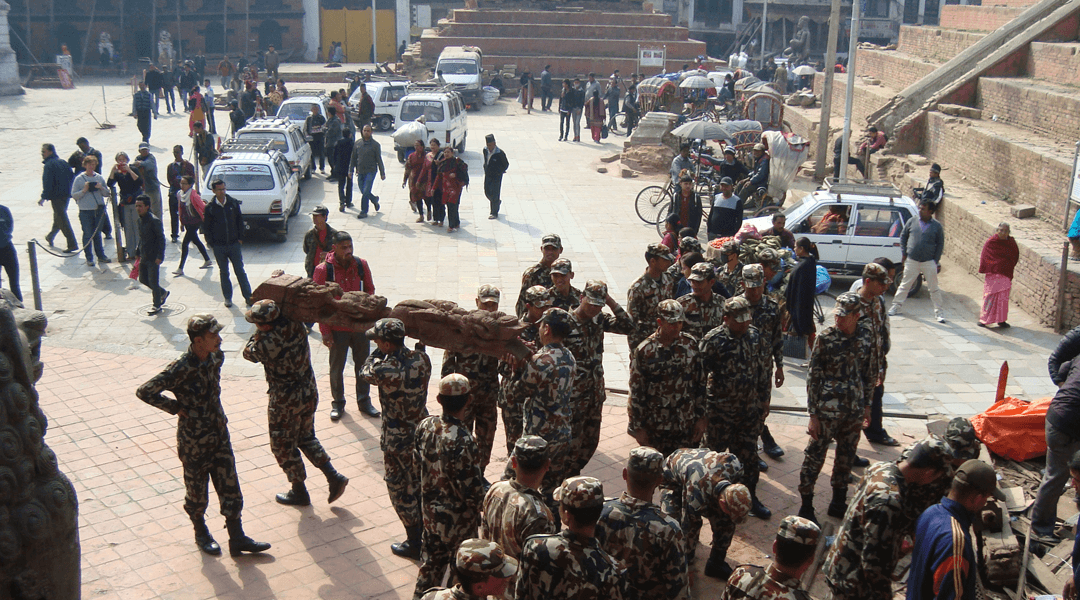
Earthquake 2015 and Nepalese Heritage
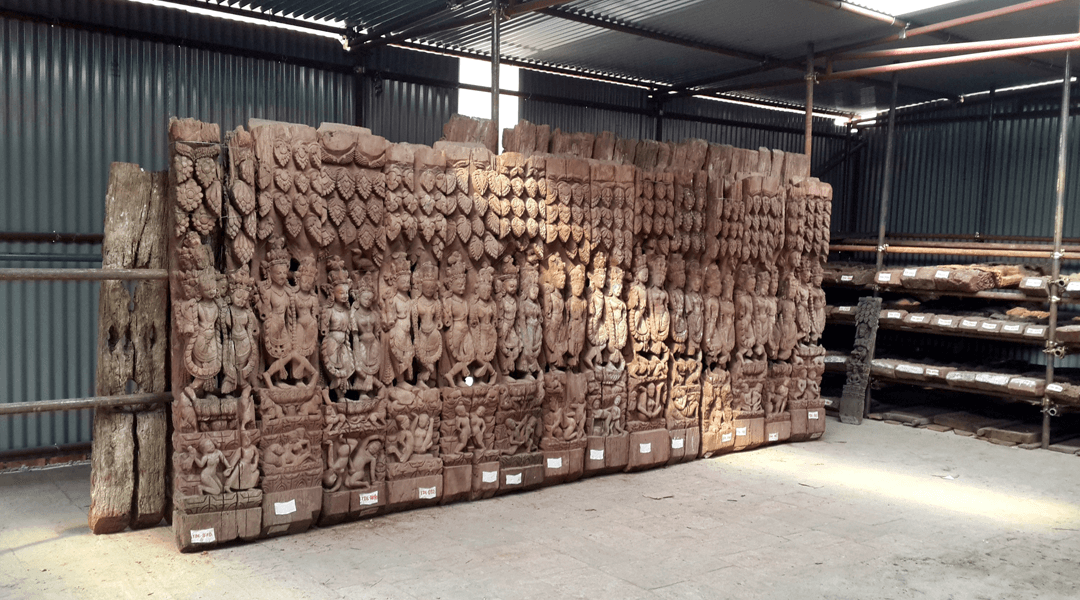
On the 25th April 2015 a massive earthquake with a magnitude of 7.6 on the Rector scale hit Nepal. Earthquake brought the biggest damage to the cultural heritage ever seen by this generation. This earthquake affected 34 districts with huge physical destruction. More than one thousand monuments were suffered by this earthquake. Immediately after the earthquake the 'Emergency Heritage Rescue Team' was formed in the Department.
Salvaging, Inventorying and documentation
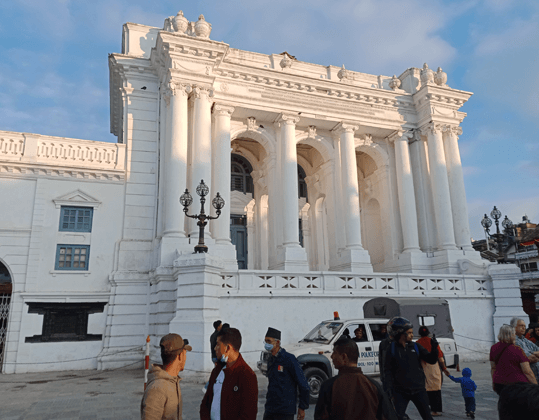
Since I have been serving for World Heritage Conservation Section of the Department as an Archaeological officer, during the rescue period after the earthquake, I was deployed as a focal person for the preliminary documentation of the damage in seven Protected Monument Zones of Kathmandu Valley World Heritage Property. The rapid evacuation, rescue and protection of various elements of archaeological, historical and cultural value was the need of the time. Salvaging and inventorying of the damaged heritage elements when there were frequent aftershocks was a really tough and challenging job we performed. We realized that the coordination with local authorities and local people, sentimentally attached with the monument and site directly, is a must for such works in adversity.
We also realized that the close coordination with national security forces which are deployed during such disasters also is very important since they may lack adequate knowledge on sensitivity of such property.
We documented the damages and they were categorized as collapsed, partially damaged and generally damaged. In the case of partially damaged one, we came to know that it is another challenging job to have detail documentation and to provide at least preliminary idea whether the structure should be demolished totally or there are possibilities to conserve without dismantling it.
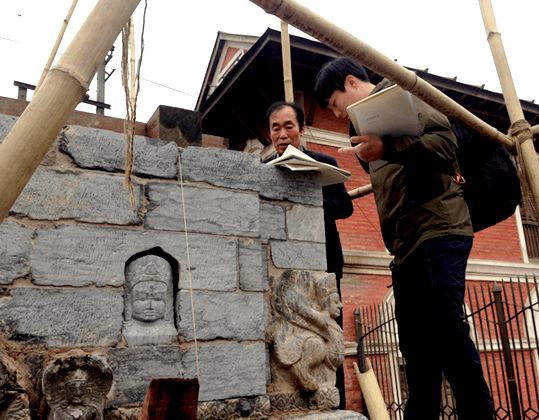
Rehabilitation after the Earthquake
After the devastating earthquake, Nepal not only faced a huge challenge to preserve the long standing heritages but also enjoyed an opportunity to introduce sustainable and authentic conservation techniques. Although Nepalese heritages suffered a severe loss due to this disaster, yet this unexpected incident opened up so many avenues for adequate research of heritage architecture.
After earthquake, various opinions on the conservation and reconstruction of these heritages were brought forth, debate and arguments were floated. Consequently it prompted to formulate a conservation guideline as a major guiding tool. An Earthquake Response Coordination Office (ERCO) was established in the Department. Being one of the few members of ERCO, I also had had the opportunity to contribute for drafting the above mentioned 'Reconstruction Guide line' and doing many other coordination works.
The earthquake also attracted the attention of national and international concerned agencies and people. For me personally, the experience of organizing those various experts’ meeting in national and international level and playing the role of a facilitator in those various meetings and seminars were overwhelming.
Today Nepalese heritages are cherishing the steady implementation of the reconstruction plans. While evaluating the past few years on the occasion of 5th anniversary of 2015 earthquake, more than 60 percent damaged heritages are now rehabilitated keeping their original beauty and authenticity intact without destroying their cultural importance. Out of 140 damaged monuments within KVWHP, 112 monuments are already restored in the close inspection of World Heritage Conservation Section where I belong.
Coordination with multiple authorities
There was a socio-political pressure to rehabilitate the damage as soon as possible. But it was not possible to handle the massive rehabilitation work only by the Department. So, the conservation responsibility was assigned to various agencies. The archaeological officer is the one who is rigorously evolved in coordinating and corresponding with various authorities for this purpose.
Training and Awareness Program
To keep the authenticity of the materials and traditional techniques intact in the massive rehabilitation works carried out by various authorities was a herculean task for the DoA. Raising the awareness in different levels about the use of traditional material is always a tough job. During the period of massive damage, the lack of skilled human resource came as a major setback to accomplish the rehabilitation works. However, several training and awareness programs were organized. It was capitalized as an opportunity to aware the people and transfer the skills to young generation. I, as an expert of the field and an officer of the Department, take part in almost all of these trainings and awareness programs in different capacities, sometimes as an organizer or a manager and mostly as a trainer.
CHIMS: Documentation Center
Cultural Heritage Information Management Systems has been established in the Department for the better documentation of the cultural heritage of Nepal. This database system is developed using the open platform of the 'ARCHES' a software platform developed by the Getty Conservation Institute and World Monuments Fund. World Heritage Conservation Section has taken the lead in this information management work in which I also am involved as one of the members of the 'Documentation Unit'. CHIMS is going to be launched shortly.
Conclusion
Under the leadership of World Heritage Section, I am entrusted with the responsibility of assisting the work of world heritage site conservation and management. It encompasses the wide range of activities such as dealing with various stakeholders in heritage issues, documenting and preparing detail report of the all restoration work within World Heritage Site carried out by different authorities, conducting trainings and awareness programs etc. My participation in CPI program has largely enhanced my performance in various works mentioned above and the DoA has been considerably benefited.

Debendra Bhattarai (Nepal)
He is working in department of archaeology, government of Nepal. He participated in Cultural Heritage Expert Research Fellowship (2016) at Korea Cultural Heritage Foundation


