Technologies and Cultural Resources
For each museum, audience and visitors are always the “priority.” In order to meet their needs to learn and enjoy the cultural and historical value from museums, particularly during the COVID-19 pandemic, the Viet Nam National Museum of History (VNMH) had to revise and redirect activities with application of technology in interpreting collections/exhibitions. Technology provides the ability to connect, interact as well as acquire information on museum objects. It diversifies activities to create attractive products and provides the audience with a different experience, thereby attracting more visitors.
The application of digital technology in preserving and promoting cultural heritage at the VNMH to create a database with detailed information and provide better experience to the users has been being carried out for many years. Moving towards building a digital heritage (E-Heritage) for Vietnamese cultural heritage, the VNMH has promoted, upgraded, and updated technology applications and put them into operation for audiences.
1. Virtual Exhibition
The VNMH is one of the first museums in Viet Nam that applied 3D virtual technology (virtual reality) in presenting exhibitions. Since 2013, special exhibitions were introduced through this technology with the aim to serve various types of audience, especially for those who have not yet had the chance to visit the museum. This was also a way to record and document collections once the temporary exhibitions finish. Then, parts by parts of the permanent exhibitions were introduced using virtual technology through the Museum website. Thus far, the VNMH has received positive feedback from the public and other museums. Particular attention was called to the interactive section, which allows visitors to observe minute details – patterns, decorations, motifs of significant objects.
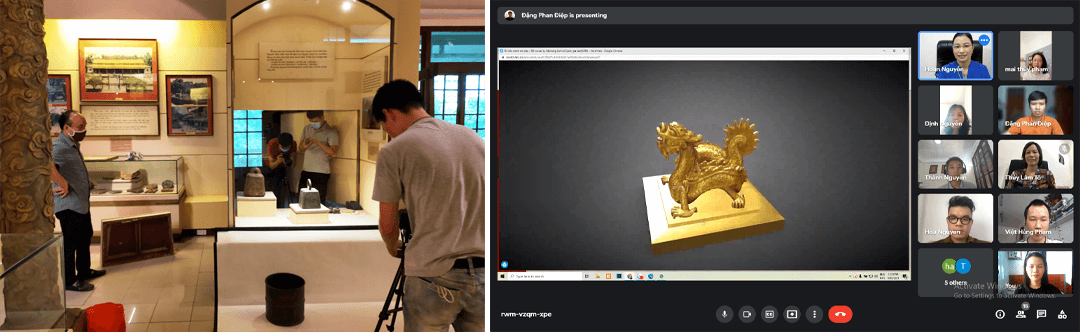
<Preparing for the 3D virtual exhibition while the Museum closed during the pandemic>
Viewing 3D objects provides visitors with easier access to observe the full details of objects, as opposed to view them inside glass cases.
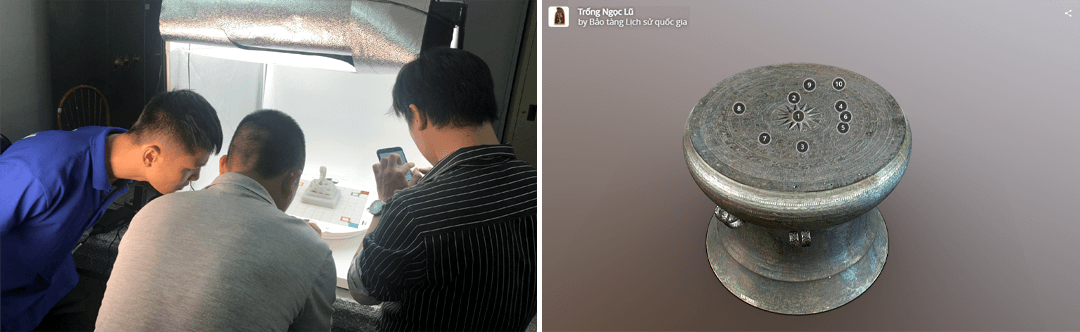
<Technology staff processing 3D objects for the virtual exhibition>
Since 2020, the VNMH has researched and upgraded 3D virtual applications to introduce the exhibition "National Treasures of Viet Nam” which are preserved at the VNMH. The content was not only updated and supplemented, but the access to the collection was also modernized. The information for each national treasure was introduced in more detail on different levels in terms of basic information, images, clips, 3D objects, research material, references, and even mini-games. Thus, the exhibition now serves a wider audience with various needs.
2. Online Tours
When COVID-19 broke out in early 2020, many activities of the VNMH were postponed due to the social distancing and lockdown. In order to overcome it, the idea for a free online tour from the Museum’s Volunteer Club was implemented to make sure visitors continue to have a chance to enjoy and access to culture and history through the museum collections. A virtual exhibition was first introduced in the VNMH through the Zoom platform with “breakout rooms,” which are convenient for organizing and managing the tour.
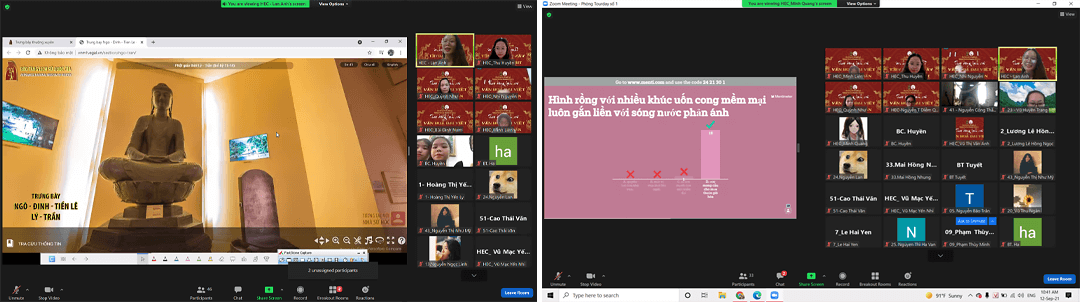
<Online Tour>
Visitors had the opportunity to enjoy the museum’s permanent collections and listen to young and enthusiastic volunteer tour guides. In the virtual tour, objects were visible and clearly seen with 3D exhibition, powerpoint, and videos. At the end of the tour, visitors took part in a Q&A session with the guides and short games on the Menti or Quizz platforms, both of which were designed to enhance the learning dimension of the experience.
The VMNH has received positive comments and feedback by questionnaires, that helped to improve the quality of the virtual tours. Online exhibitions have been spreading steadily, attracting a broader audience, particularly, students from all educational levels. In fact, the Museum has been conducting virtual tours to selected schools, going from class to class and presenting a wide variety of themes with the cooperation of teachers and parents. The virtual tours have proven to be a rich opportunity for students to learn about the value of documents, artifacts and objects within the collection, exhibited through display at the VNMH during the pandemic. It has proven so successful that the museum plans to continue this program monthly even after we have returned to the “new normal.”
3. Online Courses
The clubs “I Love History” and “History Classes” of the VNMH have attracted a great number of students in Ha Noi and other provinces, becoming a convenient “brand” for the museum.
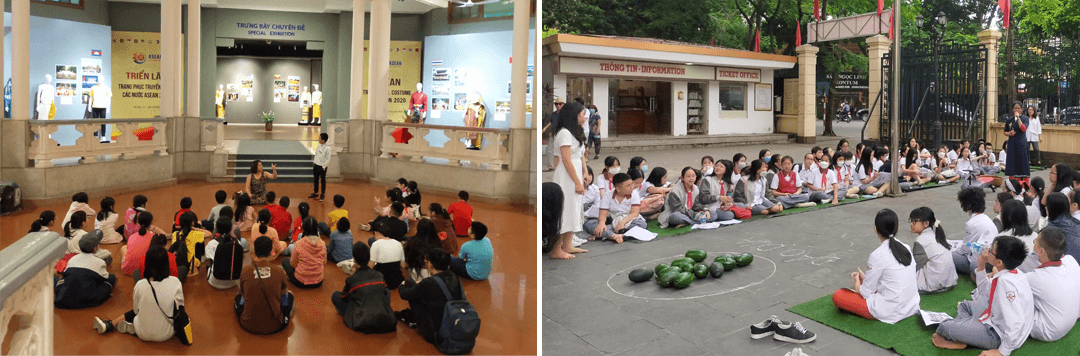
<Learning and experiencing at the VNMH>
Apart from the education programs, in recent years, the VNMH has actively applied technology to promote the historical and cultural worthiness of the collections on display to the general public (particularly the youth). These programs have proven consistently effective since their first launch in May 2019, before the emergence of the COVID-19.
When the pandemic broke out in 2020, the educational programs were further enhanced with current technology. The VNMH has applied modern technology to organize online history courses that utilize the museum’s collections, as part of the virtual tours via Zoom, Google Meet/Microsoft Teams. These online courses ensure uninterrupted learning of Vietnamese history and culture during lockdown, as well as to students who live too far away to visit the museum even under normal circumstances (such as students in the provinces or overseas). From June 2020 to July 30, 2022, the museum organized 685 lessons for 19,266 school students in separate groups. From June 2022 to November 2022 the VNMH collaborated with other museums and monuments in all the country to organize online courses to teach about history and culture of different areas of Viet Nam. It has proven that the online educational programs of the VMNH were not only carried out during the COVID-19 pandemic, but also for long term educational programs together with on-site programs.
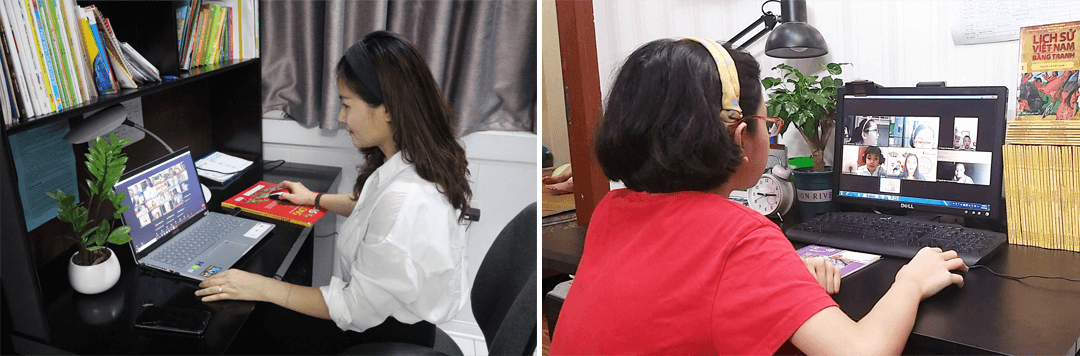
<Online Classes>
The outstanding advantages of online courses include attractively designed lessons with condensed content, vivid images, documentary films and cartoons, combined with storytelling and games, which the students were excited and interested to experience. The online courses help students organize their learning time while saving time on traveling, making it a suitable direction of education in this era of technology, especially during times of pandemic.
4. App for Audio Guide
In 2014 the VNMH launched an audio guide for handheld devices. It has proven to meet the needs of visitors. In early 2021, the museum upgraded the device and supplemented the application with QR codes that can be scanned with smartphones. The app, compatible with Android and iOS, is easy to use with its simple interface features that are eye-catching and easy to understand. The app is also convenient for updating and supplementing content including different languages. The audio guide also includes 96 texts at different levels of depth from general introduction to diverse topics and collections, offering more detailed information of significant objects.
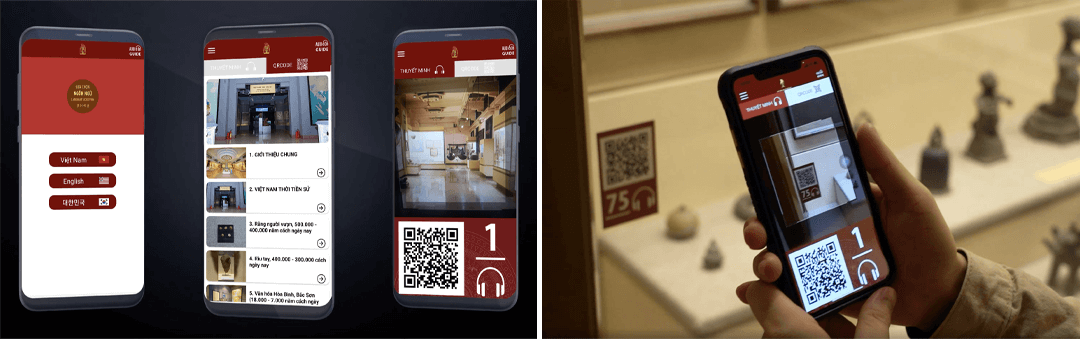
<Interface of the App for Audio Guide of the VNMH>
The texts introduce Vietnamese history from the Prehistoric period to the end of the last dynasty of Viet Nam (1945). The app allows visitors to select what they wish to listen to without a live guide, at their own space. The brochure (with map) for the audio guide and priority texts are noted for 60 minutes, 120 minutes, and 180 minutes in three languages–Vietnamese, English, and Korean, with more languages to be provided. The step-by-step process that the VMNH took to modernize user-experience activities has provided visitors with renewed, convenient, and diverse accessibility suitable in the current era of digital technology.
In other museums all over the world, the application of technology in interpreting exhibitions has become an indispensable aspect. For the Viet Nam National Museum of History, however, it can be difficult to research and develop content for the effective application of technology due to specific requirements they have to satisfy. For example, there are documents and artifacts that are valuable in terms of historical and cultural significance, but with little aesthetic or artistic value such as works on paper and documents. It has become challenging to apply 3D technology in making them more attractive to the general public.
The challenge is to research and choose which technology application is suitable for every artifact to maximize application efficiency. Technology is only a tool to convey and enhance the effectiveness of promoting content that is lively and attractive to the public’s eyes. If quality of the content is poor, the application of technology will not guarantee attractiveness from its audience. To make virtual exhibitions interesting, it is not only necessary to invest in synchronous technology, transmission lines, and cooperating costs, but in improving content as well.
The application of digital technology in preserving and promoting cultural heritage in museums and monuments in Viet Nam in general, and the VNMH in particular, has its advantages and disadvantages. The challenges are that digital technology develops rapidly, while the database storage platforms, technical infrastructure (internet network), investment funds, content preparation, documents, and human resources for buildings and operations at the museums are very limited.
The difficulties of the VNMH in applying technology for improved interpretation of exhibitions and collections can be listed as follows:
- Human resource is one of the major difficulties of the VNMH. There is a lack of IT personnel due to persistent staff cuts. Educators, therefore, have to research the content while simultaneously self-learning the necessary IT skills for building software (despite its challenges for older members of the museum staff).
- Limited budget for new applications of technology and good equipment for operation of technology programs. Due to the rapid developments in IT, existing technology easily becomes out-of-date. Updating and upgrading the use of modern technology requires substantial effort, intelligence, and, above all, budget.
- Poor internet connection in general.
To overcome these challenges, it would be ideal that every member of staff apply and update themselves on the latest trends in IT. This should be accompanied by a budgetary allocation in order to train museum staff with these skills, as well as an accompanying allocation of human resources to update the quality of equipment (particularly in choosing a service provider that could guarantee stable internet access).
In order to attract visitors to the VNMH, it is necessary to understand the needs of the public and adjust and innovate accordingly. The application of technology in interpreting museum collections is one of the most important solutions for the VNMH, as it is with other museums in general. The COVID-19 pandemic has made the use of technology more urgent and important than ever. The use of improved and updated technology will not only promote the VNMH during this pandemic, but will guarantee sustainability as we return to the “new normal.
Notes :
1. You can access the website of the Viet Nam National Museum of History by the link: http://baotanglichsu.vn
where you can also visit the 3D virtual exhibitions for both permanent and special exhibitions.
2. Visit the 3D virtual exhibition "National Treasure of Viet Nam" by the link: https://baovatquocgia.baotangso.com
or through the website of the VNMH.
3. Download the App for Audio Guide by the link: http://app.baotanglichsu.vn
4. The author’s contact: Nguyen Thi Dinh (Mb/viber/whatsapp: +84914380069, email: dinhnguyenbtlsqg@gmail.com
References list
1. ICOM, 2020. Museums, museum professionals and COVID-19
https://icom.museum/en/news/museums-museum-professionals-and-covid-19-survey-results
2. Nguyen Thi Thu Hoan, 2001. Role of the Vietnam National Museum of History in education for young generation, thesis of M.A,
Hanoi University of Culture.
3. Nguyen Thi Thu Hoan, 2020. Vietnam National Museum of History with access and application of technology,
http://baotanglichsu.vn/vi/Articles/3090/71554/bao-tang-lich-su-quoc-gia-voi-viec-tiep-can-va-ung-dung-cong-nghe.html
4. Truong Quoc Binh, 2002. Strengthen the research and application of scientific and technological achievements to innovate museum
activities in Vietnam, Summary record of a conference, National Museum of Vietnamese History.
5. UNESCO, 2020. Museums facing COVID-19 challenges remain engaged with communities
https://en.unesco.org/news/museums-facing-covid-19-challenges-remain-engaged-communities
6. Walter L.Crimm, Martha Morris and L.Carole Wharton. Planning Successful Museum Building Projects.
A division of Rowman & LittleField Publishers, INC.

Nguyen Thi Dinh
2022 CPI Cultural Administrator Training Program Participant
Deputy Head, Department of Education and Public Viet Nam National Museum of History, Vietnam


