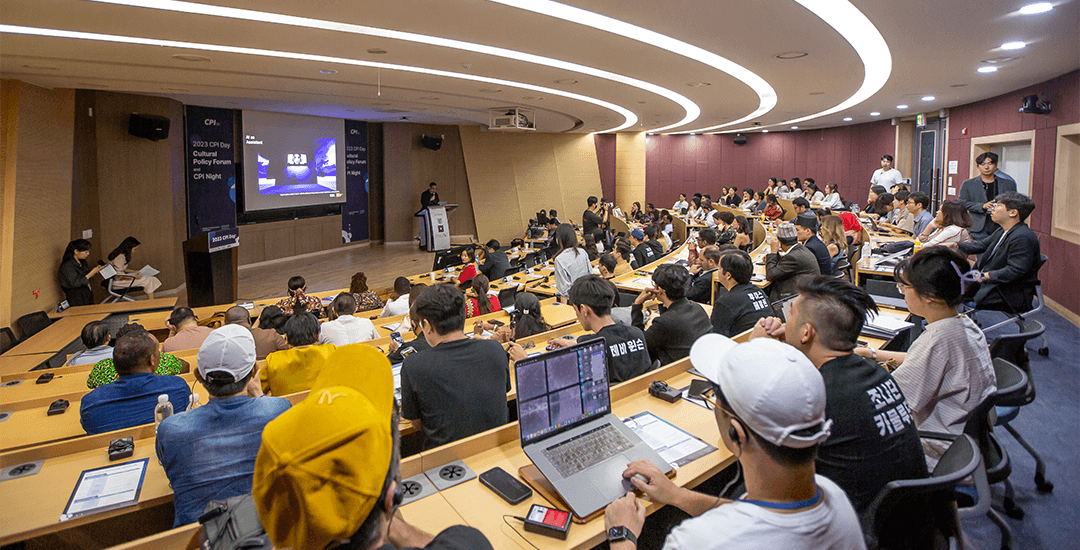
2023 CPI Cultural Policy Forum – Keynote Speech
“Art and Creativity in the Age of Artificial Intelligence:
The Emergence of a New Artistic Landscape”
September 14, 2023
New Media Artist Jinjoon Lee
Professor at KAIST (Korea Advanced Institute of Science and Technology)
Graduate School of Culture Technology
Director of KAIST Center for Art and Technology
Doctor of Philosophy in Fine Arts, Faculty of Humanities, University of Oxford
Fellow of the Royal Society of Arts (FRSA)
The age of artificial intelligence (AI) is advancing more rapidly than we could have foreseen, heralding significant transformations in the realms of art and creativity. Traditionally, art has been regarded as the fundamental way to express the human emotion and experience, but now AI is not only modifying but also generating art, challenging conventional notions of creativity and artistic production.
Art, in its myriad forms, has been a cornerstone of human existence since time immemorial. It captures the essence of human needs, emotions, and cultural identity. "Human creativity" has always been at the heart of artistic expression, from ancient cave paintings to contemporary new media art. However, with the advent of AI, we are witnessing the emergence of a novel breed of "artist" operating through algorithms and machine learning.
As we weave fresh threads into the magnificent tapestry of "human progress," gleaming with the cool brilliance of artificial intelligence, I propose a 5-step AI creative process to initiate a deeper understanding of the debate surrounding the essence of creativity.
1. AI as a Tool
In this new era, AI has transformed into a potent artistic tool. Artists across the globe are harnessing AI to innovate and push the boundaries of their craft. Take, for instance, the remarkable work of Refik Anadol, a media artist who leverages data and machine learning to craft breathtaking visualizations. His creation, "Melting Memories," utilizes the neuroscience tools of the University of California, Los Angeles (UCLA)'s Neuroscape Center to construct dynamic, dreamlike landscapes using brainwave data—a splendid fusion of human intellect, data, and AI-powered art.
2. AI as an Assistant and Facilitator
AI is increasingly assuming roles beyond being just a tool; it now acts as an assistant, aiding artists in their creative endeavors. AI can sift through vast volumes of data, identify trends, and offer insights that may elude human perception. Consider the work of musician Taryn Southern, who utilized the AI platform Amper Music to craft her 2017 album, "I AM AI." The platform provided initial musical arrangements, which Southern used to compose her entire debut album, showcasing how AI can serve as a creative collaborator, sparking ideas and providing human artists with a foundation for new creations.
3. AI as a Collaborator
Taking a step further, AI emerges as a genuine collaborator in the creative process. In such scenarios, AI engages in dynamic dialogues with artists, proposing new directions and challenging preconceived notions. The collaboration between artist Harold Cohen, a professor at the University of California, and his AI program, AARON, serves as a prime example. AARON has been creating art with Cohen since the 1970s, learning from his input and gradually refining its technique and style. This partnership exemplifies the thrilling possibilities when human creativity meets machine intelligence.
4. AI as an Artist
Arguably the most controversial aspect is AI's current capability to autonomously generate art. Equipped with machine learning algorithms trained on thousands of artworks, AI can produce entirely new pieces without human intervention. A noteworthy instance is the AI-generated "Portrait of Edmond de Belamy," crafted by the art organization Obvious. The piece fetched an astounding USD 432,500 at a 2018 Christie's auction. Despite its algorithmic origins, this AI-generated artwork exhibits a sophistication and depth that challenge traditional notions of art and authorship. In the lower right corner of the piece, a complex mathematical formula replaces the artist's signature, signifying that it was created by a computer algorithm rather than a human.
5. Symbiotic Relationship
This development marked a new acceptance of AI in the art world. However, in 2023, the fusion of AI and art is evolving at an astonishing pace. Like a tireless blacksmith, AI forges and creates artworks continuously. Every day, a digital forge produces numerous creations that are both bewildering and fascinating.
Nevertheless, this novel symbiotic relationship between art and AI opens up fresh horizons and ignites intense debates.
1. Can AI-generated art possess the emotional depth or intent found in human-created art?
2. Are machines genuinely creative, or do they merely reflect their training data, mimicking human creativity based on patterns and algorithms?
3. Questions of authorship also come to the forefront. Who are the true artists: the AI or the developers who created and trained it?
These inquiries delve into the core of our understanding of art and creativity, compelling us to reevaluate our roles and capabilities in an increasingly AI-driven world. As we stand on the precipice of this new era, the words of Lewis Mumford, an American historian and philosopher, continue to resonate:
"Why have we become technical supermen but moral infants,
giants in knowledge but pygmies in wisdom, industrial Lords of Creation
but lackeys of self-destruction?" - Lewis Mumford, 1951
Art, in its most profound form, has always been a reflection of the human spirit. It is a language that communicates with our emotions, experiences, and existential journeys. Can a machine, devoid of consciousness and human touch, genuinely partake in this intimate dance of creation? I find myself pondering these questions as I gaze upon my digital canvas.
Much like Prometheus's fire, AI is a potent technology with the power to illuminate or extinguish. It can offer artists new horizons, introducing fresh forms and patterns. For instance, Google's DeepDream introduces technology that transforms images in surreal, dream-like ways, expanding an artist's creative palette unexpectedly. However, the intensity of this fire carries the risk of erasing the essence of human creativity: contemplation. In my view, the mechanization of creativity runs the risk of transforming art into a sterile computational algorithmic exercise devoid of human’s introspection.
I implore us to exercise caution as artists embrace AI beyond the role of a mere partner. I believe that AI should serve as a tool or enabler, enhancing rather than replacing the unique ability of humans. In the realm of digital music, for example, AI systems like OpenAI's MuseNet generate intricate compositions spanning various styles and genres. However, as artists intertwine their narratives with AI, they face the challenge of preserving both their distinctive imprints and personal connections with their creations.
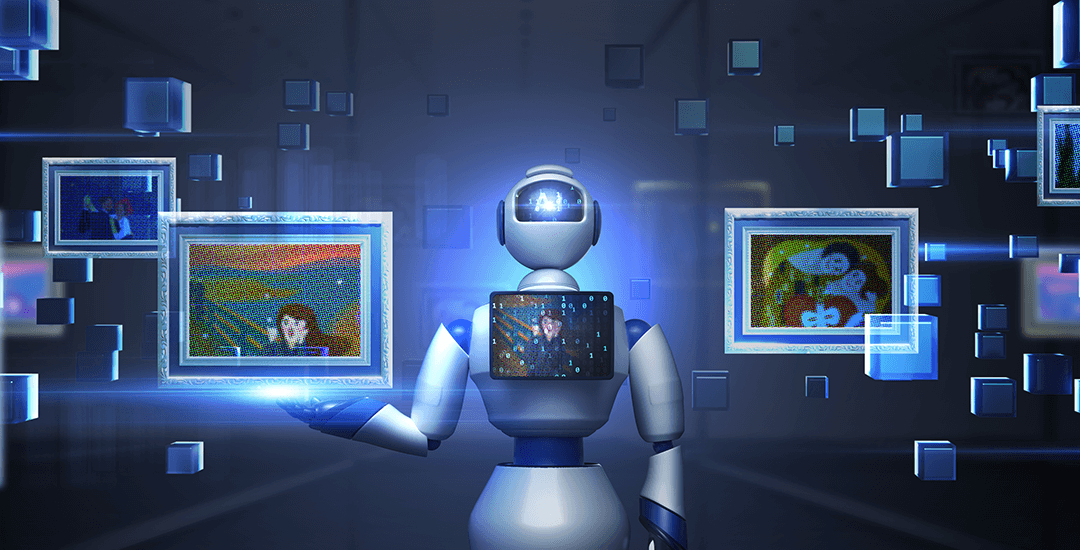
The concept of the "democratization of art" through AI, heralded in the new millennium, seems to promise creative freedom for all—a world where anyone can be an artist. However, as artistic production morphs into an algorithmic game accessible to everyone, the arduous path to mastery that artists have historically traversed appears undervalued. While apps such as DeepArt and Prisma can transform images into the styles of renowned paintings, AI's digital brushstrokes, no matter how technically proficient, can never truly rival the human touch that has danced with color and canvas for centuries.
We must bear in mind that technology should not subjugate but rather serve the essence of humanity. As we navigate the uncharted waters of AI and art, we should be guided by the compass of humanistic values. The challenge and opportunity lie in ensuring that AI becomes an enriching force, harmonizing with the enduring human spirit rather than disrupting it.
Art generated by AI, if it fails to resonate with the human spirit, risks becoming a mere cultural and industrial commodity, diluting its power to reveal profound truths. Theodor W. Adorno, a leading figure in Germany's Frankfurt School, voiced his criticism against the mass production, standardization, and commercialization of culture. For him, authentic art transcended superficial aesthetics; it served as a conduit for truth and a beacon that illuminated the contradictions within society. With the rise of AI, we are compelled to ask a fundamental question: Can a machine devoid of human consciousness wield the torch that unveils the essence of art?
AI-generated art can be seen as a product of society's unquenchable thirst for novelty and efficiency. Even the most meticulously crafted digital strokes lack the soulful touch that human creativity has bestowed upon colors and canvases over the ages. There's a risk of art becoming a homogenized commodity, a mundane spectacle reinforcing societal norms as creativity becomes mechanized.
Yet, within the folds of this critique, a glimmer of hope emerges. I firmly believe that art can resist the commodification inherent in the cultural industry, maintain its autonomy, and continue to shed light on pressing societal issues. If AI-generated art can fulfill these roles, Adorno might have considered AI technology a valuable development.
Imagine an AI that creates artwork reflecting the social biases ingrained in its training data. These artworks can serve as societal mirrors, revealing uncomfortable truths about our prejudices, fulfilling the vital role Adorno believed true art should play. I've also been engaged in visualizing collective memory using AI. Projects like "Irworobongdo," hosted at Changgyeonggung Palace in 2023, aimed to provide an experiential sense of a space called "Utopia" transcending time and place by leveraging AI to imagine conceptual spaces, including nature and cities, that surround us.
In the grander scheme of things, we stand at the dawn of a new era, performing a complex dance of progress with AI. The rhythms of this dance will not only shape the future of art and creativity but also etch the narrative of human civilization in the annals of the AI era. We must synchronize our steps to this rhythm, heed the echoes of Adorno's wisdom, and become discerning spectators and active participants in this grand spectacle.
In conclusion, we are reminded that despite the rapid march of technology, the pivotal role of art remains undiminished. It becomes even more imperative to delve into the essence of humanities and art, rooted in profound insights into the human condition and creativity. Time will ultimately determine whether AI can genuinely become a contributor to this masterpiece, expressing creative truth, or if it remains a mere tool of the cultural industry. As the curtain rises on the AI era, we must heed the critiques of Mumford and Adorno and be prepared to challenge, question, and shape the narrative of art and creativity in this age of AI.
Amidst the ongoing debates, one thing is abundantly clear: AI is not here to replace human artists but to complement their creativity.
1. To begin, AI broadens our creative horizons by offering novel methods of seeing, comprehending, and creating. Whether by helping us visualize the infinite or recollect our collective memories, AI opens new pathways for artistic exploration, providing fresh perspectives to observe and interpret the world.
2. Furthermore, as AI learns from its own data, we can anticipate the emergence of new "creative mutations," akin to evolutionary theory, albeit with the risk of biases and overly generalized outcomes by inbreeding. There's no denying that such innovative mutations have propelled human evolution and survival, and it appears AI might follow a similar trajectory in exceptional cases.
3. It's also worth considering the possibility that AIs could create art for themselves rather than solely for humans. Art that resonates with AI audiences could introduce an entirely new dimension to human creativity. The age of artificial intelligence is redefining the very essence of art and creativity in unprecedented ways.
To navigate this novel landscape, we, as humans, must embrace AI's potential while maintaining a profound appreciation for the "humanity" at the core of all creativity. As we transition into the era of AI, we can look forward to a future for art that is rich, diverse, and exciting, marked by a vibrant fusion of human and artificial creativity. Alongside this evolution, the ability to create or appreciate art will become the ultimate hallmark of a person.
Now I can not help to say that it's time to return to the "poetry,” to read verse, to teach it, in order to unlock the words that our souls long to reach.


