2023 CPI Cultural Administrators Training_Best Project Proposal
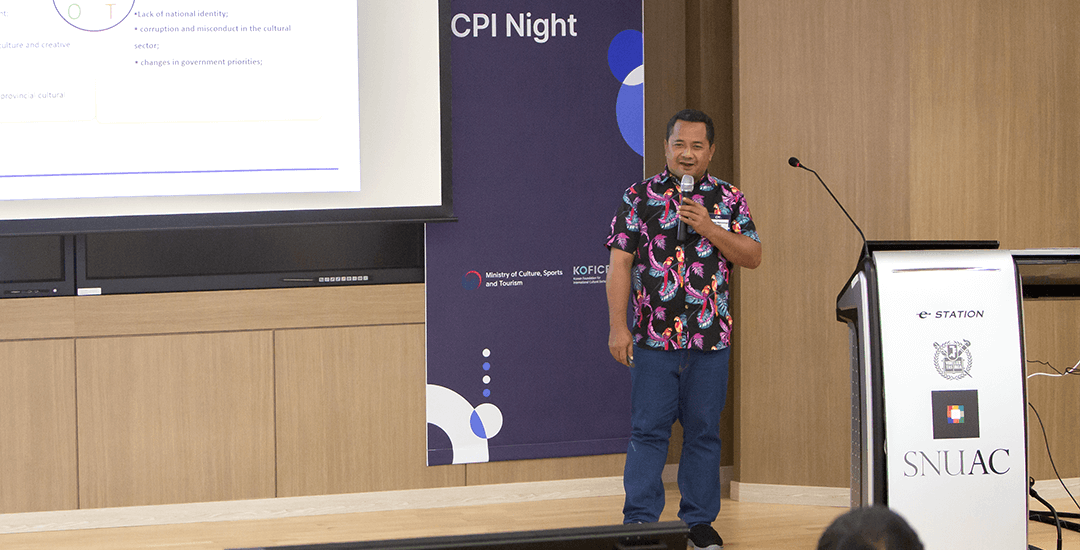
Thinking Ngiusanga Maitaki(Solomon Island)
Duration of the Project : 1 year 9 months
Expected Budget : SBD$800,000.00
Introduction
The challenge faced by the creative arts and cultural industry in Solomon Islands is due to the lack of legislation mandating responsible authorities to regulate and develop framework for the industry.
Background
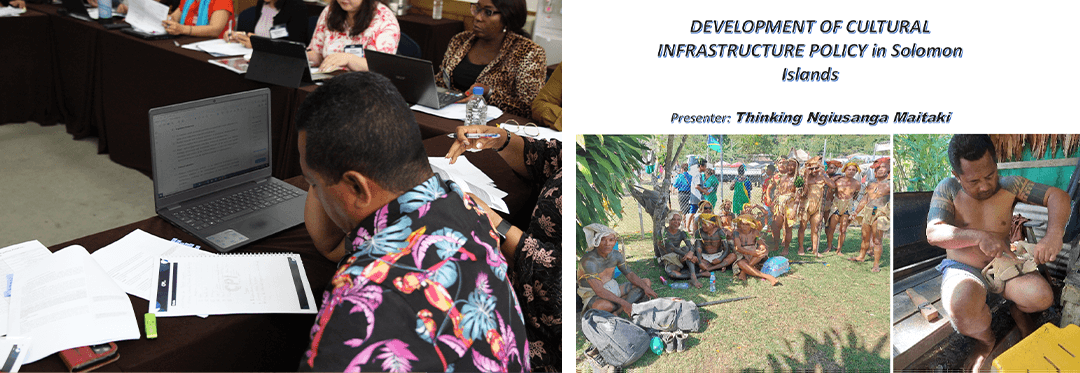
Solomon Islands, unique in the Pacific for its cultural diversity, comprises of Melanesia as the dominant ethnicity, along with the Polynesia and Micronesia. These diverse ethnic groups possess various creative skills talents, and cultures. In addition, there is a new emerging interest in contemporary arts, contemporary music, visuals arts and other creative arts.
Solomon Islands stands out in the Pacific due to its cultural diversity, new emerging interest in contemporary arts, and the identified economic potential of the cultural industry, as cultural artwork is integrated into day-to-day practices.
Rationale
Developing an arts and cultural infrastructure policy is an alternative to creating an inducive environment for investment in cultural Infrastructure. This will enable the establishment of institutional and international relations to promote arts and culture. This is to support the growth of the arts and cultural economy in the Solomon Islands.
Current Issues and Challenges
The linking of producers and consumers is the pathway encourages collaboration and sharing of arts and cultural knowledge, creativity, and innovation.
However, the lack of government legislation on arts and culture poses a challenge, as cultural infrastructure development is not a focus in the National Culture Policy developed by the Culture Division, Ministry of Culture and Tourism. Additionally, the lack of cultural space and facilities, has impacted the production of arts and cultural activities, leaving the cultural and the creative economy under-exploited.
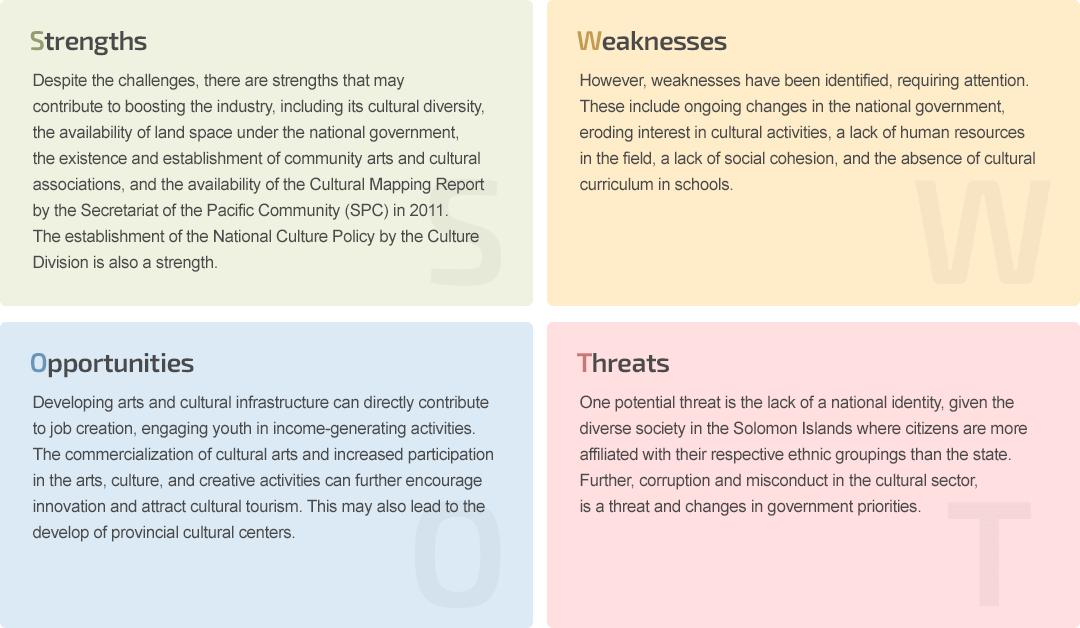
SWOT Analysis
However, the project proposition will be conducted based on the outlined brief process. (see Appendix 1)
Output
1. Survey designing
2. Conduct nationwide survey research;
3. Conduct capacity building;
4. Conduct Line ministry consultation program;
5. Public hearing/ conference;
6. Identify status of existing cultural infrastructure;
(rural and urban areas)
Outcome
ㆍFinal draft of the Cultural Infrastructure Policy;
ㆍBetter skills in conducting consultation and survey;
ㆍIdentification of types of cultural infrastructure(demand and need);
ㆍDevelopment of detailed plans;
ㆍCultural infrastructure project;
ㆍDraft cultural facilities management plans;
Risks
ㆍChanges in government priorities;
ㆍLack of social cohesion;
ㆍLack of national identity;
Solutions
ㆍDevelop a resilient cultural and creative ecosystem;
ㆍEncourage and promote participation in arts, culture and creative activities;
ㆍEncourage and promote the ideal of nationality;
ㆍPromote the ideal of interdependency(scarcity and specialization);
Conclusion
It is very important to invest in cultural infrastructure as it drives innovation and creativity. Involvement in these activities and the sharing of skill knowledge not only contributes significantly to the national economy but also provides a lens through which we see and interpret who we are.
APPENDIX 1.
[Output 1]
Conduct survey research on Cultural Infrastructure.
Activity 1.1.
design survey; mixed methodology, interview and questionnaire;
Activity 1.2.
capacity building- train officers to do data collection and presentation;
Activity 1.3.
procure required equipment; (training/field)
Activity 1.4.
Identify cultural infrastructure status; (assist in policy design)
[Output 2]
Line Ministry and stakeholder consultation program.
Activity 1.1.
Conduct Focus group and online Interviews;
Activity 1.2.
organize meetings with line Ministries and other stakeholders;
Activity 1.3.
Map policy ideas from line ministries and stakeholders;
Activity 1.4.
Identify and establish the link through respective objectives;
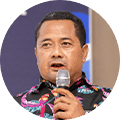
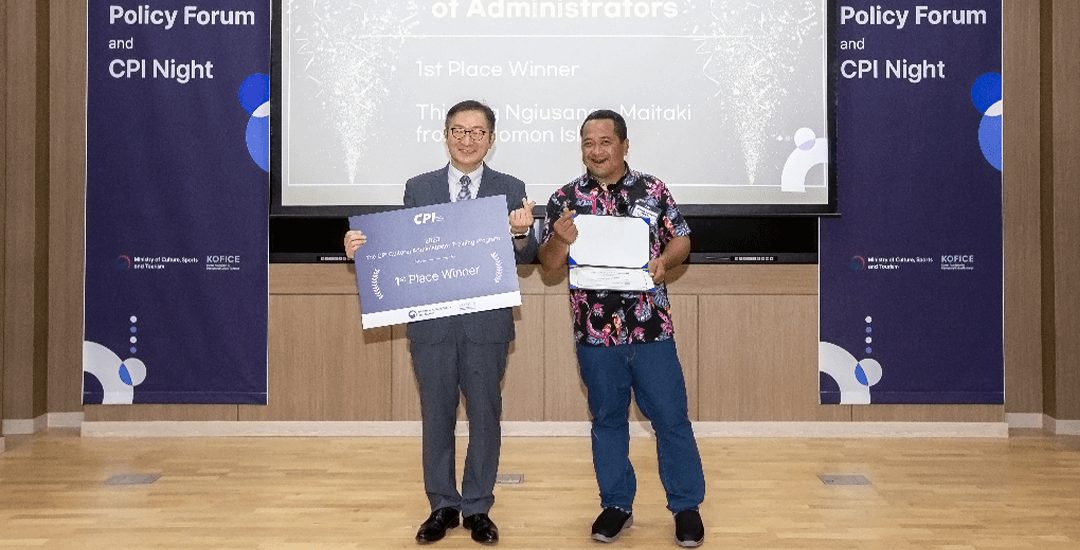
Thinking Ngiusanga Maitaki
2023 CPI Cultural Administrators Training Program Participant.
Culture Officer, Culture Division, Ministry of Culture and Tourism, Solomon Islands


