
Thailand's Draft AI Act and ASEAN's AI Norms

What the July draft does
The Electronic Transactions Development Agency (ETDA) published the revised draft in early July 2026, and comments closed on 14 August. The text sorts AI into tiers, with duties that rise with the risk:
| Tier | What it covers | Main duties |
|---|---|---|
| Prohibited | Subliminal manipulation, large-scale unfair discrimination, and other uses a national AI commission may add | Banned |
| Licensing or notification | AI systems to be designated by royal decree | Notify, register or obtain a licence before deployment |
| High-risk | Systems designated in areas such as national security, health, energy, telecoms, transport and utilities | Risk management, human oversight, operating logs, incident reporting |
| Transparency | Generative AI developers, platforms, and anyone publishing AI content on sensitive topics | Machine-readable marks, disclosure, platform labelling and reporting channels |
The transparency tier is the one that reaches creative work. Developers of systems that generate or modify images, audio or video must embed machine-readable marks identifying the output as AI-made. Anyone who publishes AI-generated or AI-altered content on a list of sensitive topics (elections, national security, investments, food and drugs, impersonation and illegal acts) must disclose it before publication. Artistic, satirical and fictional works face lighter rules. Platforms must label AI content, assess the risks and give users a way to report harmful or misleading material.
The draft reaches beyond Thailand's borders. It covers AI that affects people in Thailand wherever it is built, and some foreign providers would need a local representative. Liability is strict and joint, with few defences. Enforcement runs from corrective orders and fines to court-ordered suspension and, as a last resort, blocking. ETDA is now revising the text, which still needs Cabinet approval and a vote in Parliament. Some rules already apply in the meantime: since July 2025, advertisements made with AI must say so under a consumer protection notification.
The copyright question it leaves out
An earlier version went further. The draft principles circulated in 2025 proposed an EU-style exception for text and data mining. It would have allowed AI training on lawfully accessed works, unless the rights holder had reserved its rights or a licence was available. Rights holders objected, and the US-based Copyright Alliance urged the government to withdraw it. The July 2026 draft contains no such exception.
That leaves AI training to Thailand's Copyright Act, which has no broad fair use or fair dealing exception and no provisions on AI. In practice, training a model on protected works needs permission unless a narrow statutory exception applies. The Department of Intellectual Property made the same point about music in August. An AI voice conversion or remix, it said, may need licences from the lyricist, composer, arranger, record producer and performers, and a licence for ordinary reproduction may not cover it.
For voice actors, singers and other performers, the draft offers only indirect protection. AI content that impersonates a person falls into the disclosure category, but disclosure is not consent, and published analyses of the draft describe no new right over a person's voice or likeness. Those questions, too, remain with copyright, personality and contract law.
From regional guides to national laws
Until recently, ASEAN's approach to AI was voluntary. The ASEAN Guide on AI Governance and Ethics (2024) and its expanded edition on generative AI, released at the digital ministers' meeting in Thailand in January 2025, set out shared principles. The generative AI guide lists deepfakes and intellectual property infringement among the main risks and calls for "clear labelling practices or advanced content provenance tools". On training data it takes no position, noting that policymakers are still weighing text and data mining exceptions against licensing.
In January 2026 the ministers' Hanoi Digital Declaration committed members to "advancing policy harmonization" on AI, and the ASEAN AI Safety Network, set up in 2025, is to run its secretariat from Kuala Lumpur. National rules, meanwhile, are moving at different speeds:
| Economy | Main instrument | Status, October 2026 |
|---|---|---|
| Viet Nam | Law on Artificial Intelligence (No. 134/2025/QH15) | In force since 1 March 2026; AI-generated audio, images and video must carry machine-readable labels |
| Thailand | Draft Artificial Intelligence Act | Public hearing closed in August 2026; revision under way |
| Indonesia | Presidential regulations on an AI roadmap and AI ethics | Pending; a Copyright Law amendment is to address AI training and AI-assisted works |
| Malaysia | AI Governance Bill | Under consultation; voluntary national guidelines since 2024 |
| Singapore | Voluntary governance frameworks | No AI law; copyright exception for computational data analysis since 2021 |
Labelling is where these rules converge. Viet Nam's law and Thailand's draft both require machine-readable marks on synthetic media, in line with the regional guide. Training data is where they diverge. Singapore permits computational analysis of lawfully accessed works, Indonesia is rewriting its copyright law, and Thailand has stepped back from an exception.
Labels are the easy part
For the region's creative sectors, the gap between these two issues matters more than any single law. A label tells audiences that a voice or an image was generated. It does not tell the actor whose recordings trained the model whether she was asked, or paid.
Cross-border formats make the divergence concrete. A microdrama dubbed with synthetic voices (the subject of this series' 10 November post), a song remixed through voice conversion, or a model trained on a regional film archive may be lawful in one ASEAN market and need licences in the next.
Thailand will chair ASEAN in 2028, a year after Singapore, and the two governments agreed in September to explore cooperation on AI. If the region is to move from shared guides to compatible rules, common labelling standards look achievable. A shared position on training data, and on the rights of the people whose work and voices feed these systems, would be harder, and more useful.
Related trends: Thailand's push for AI adoption
Regulation is only half of Thailand's AI policy. The government is also pushing adoption, through public data, home-grown models and schools.
- Public data. In July 2026 the Cabinet approved Thailand's first Big Data strategy (2025–2027), prepared by the Big Data Institute (BDI). It targets scattered agency datasets and the lack of a central open-data repository, and calls for a shared data-exchange infrastructure. The government has also said future public data should be machine-readable. Under the draft AI Act, sandbox participants could obtain state data through BDI.
- AI in government. The National AI Strategy and Action Plan 2022–2027 targets AI use in 600 agencies by 2027. In August 2026, Deputy Prime Minister Pakorn Nilprapunt set out a public-sector reform built on AI, including keeping sensitive government data on a Thai-language model.
- Home-grown models. Pathumma LLM, released by the national electronics and computer centre NECTEC in 2025, is used by the Thai Parliament to summarise meetings and draft bills. ThaiLLM, a national programme led by the science and technology agency NSTDA with BDI and other partners, was formalised in April 2026.
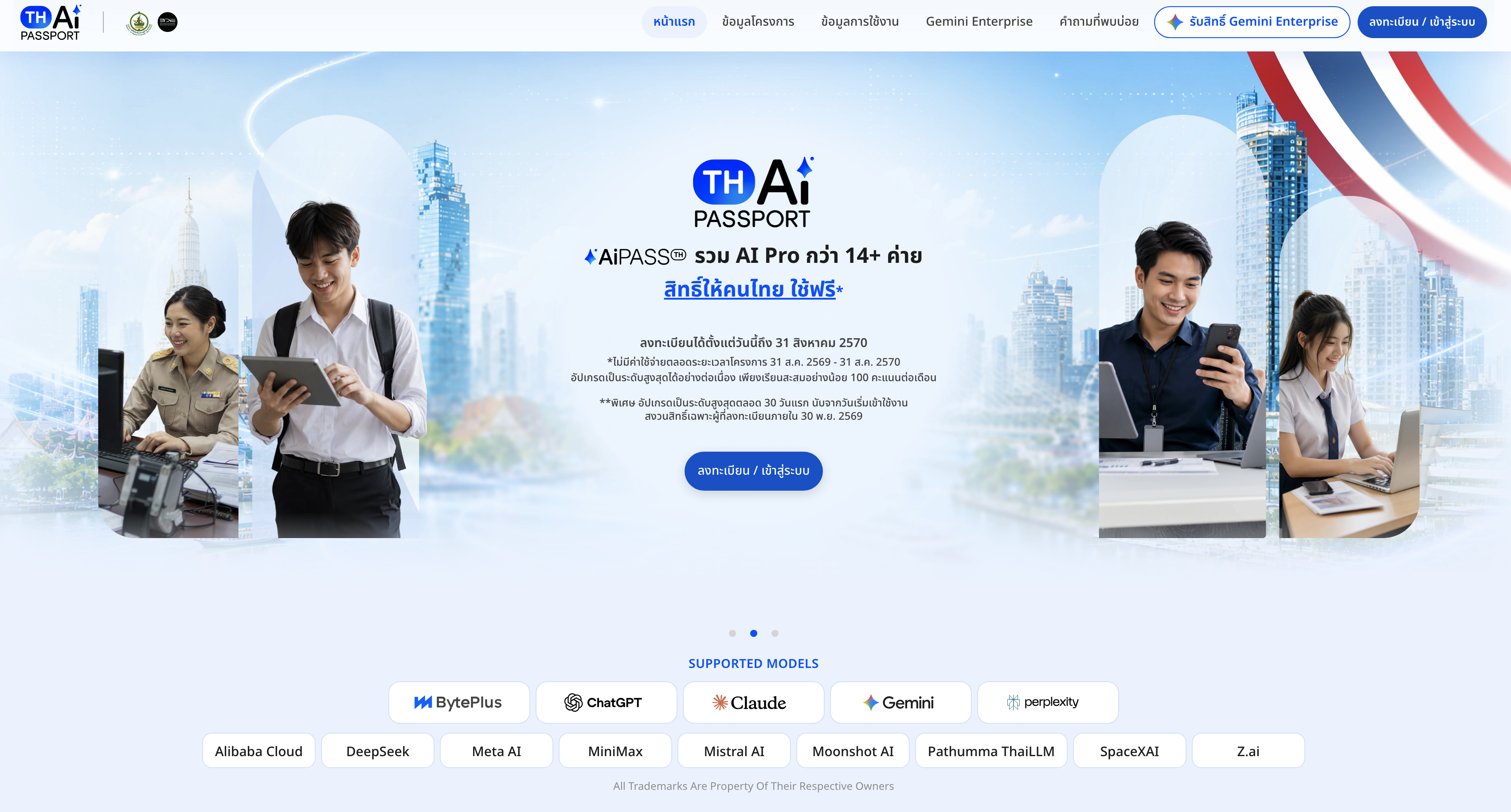
- AI for citizens. The TH-AI Passport would give five million Thais aged 15 and over a year of free access to premium generative AI tools, funded with about 1.6 billion baht from the Digital Economy and Society Development Fund. Planned for June 2026, it was put under ministerial review after criticism of its cost.
- Schools. The Office of the Basic Education Commission has produced AI teaching materials and run pilots in some 700 schools, and a programme with Microsoft trained more than 160,000 teachers by March 2026. The Ministry of Education plans an AI learning framework for teachers and students this year and will build media and AI literacy into core subjects from primary school, ahead of PISA 2029's new assessment of the area. National rules on students' use of AI have yet to be issued.
Sources
- Thailand Releases New Draft Artificial Intelligence Act — Tilleke & Gibbins, July 2026
- Thailand Draft AI Act: Seven Key Implications — Baker McKenzie, July 2026
- Thai DIP warns AI music creators of licensing risks — The Nation, 13 August 2026
- ASEAN Guide on AI Governance and Ethics covering Generative AI released — Drew & Napier, January 2025
- Vietnam: The First Law on Artificial Intelligence — Duane Morris, March 2026
- ASEAN Digital Ministers' Meeting 2026: Spotlight on AI Cooperation — Crowell, 2026
- Thailand's first Big Data plan targets eight critical gaps — The Nation, 28 July 2026
- Thailand plans AI learning framework after PISA gains — The Nation, 9 September 2026