
After DEFA: Digital Trade Rules and Creative Works

What DEFA covers
Negotiations began under Indonesia's chairmanship in 2023 and closed at a meeting of senior economic officials in Manila on 27–29 May 2026, under the Philippines' chairmanship. The full text has not yet been published, but ASEAN has set out its nine core elements: digital trade, cross-border e-commerce, digital payments, digital identity, cybersecurity, cross-border data flows, competition policy, cooperation on emerging topics such as AI, and talent mobility.
The economic case is large. ASEAN's digital economy reached about US$305 billion in gross merchandise value in 2025 and is projected to reach US$1 trillion by 2030. A 2023 study prepared for ASEAN member states by Boston Consulting Group estimates that a forward-looking DEFA could double that to US$2 trillion.
Where it touches creative work
None of DEFA's elements is about culture, but several decide how cultural content moves:
| Element | Why it matters for creative content |
|---|---|
| No customs duties on electronic transmissions | Members reaffirm that they will not impose customs duties on electronic transmissions for five years, subject to review, so streaming, downloads, e-books, games and apps cross borders duty-free within ASEAN |
| Cross-border data flows | Streaming platforms, cloud production and dubbing pipelines depend on moving data. DEFA's rules on source code and the location of computing facilities are meant to discourage unnecessary data-localisation requirements |
| Digital payments | Interoperable payments make it easier for audiences to pay for content from a neighbouring country, and for creators to be paid |
| Online safety and consumer protection | Commitments on online consumer protection, cybersecurity cooperation and anti-scam measures, relevant to subscription apps and in-app payments |
| Emerging technologies | Cooperation on AI and emerging technologies, framed as sharing best practices; nothing announced on AI-generated content or training data |
| Talent mobility | Cooperation on digital talent development and mobility, including mutual recognition of qualifications where appropriate; whether it reaches creative workers is not yet clear |
For the microdrama apps, music platforms and game publishers this series has followed, the duty-free commitment and data flows matter most. They lower the cost of serving the whole region from one hub. That benefits whoever already has scale, which today often means platforms from outside ASEAN.
What it leaves to national rules
Three areas that matter most to creators sit outside DEFA's published elements.
The first is intellectual property. Copyright, licensing and collective management remain with national law and ASEAN's separate IP cooperation. A duty-free, data-friendly market makes content easier to move, and also easier to copy; the agreement itself does not address who is paid when it is.
The second is audiovisual and cultural policy. Licensing, content classification and local-content rules for broadcasters and cinemas are national matters, and ASEAN's trade agreements have generally left them to national discretion. Whether DEFA's provisions on digital trade reach streaming services' obligations will only be clear once the text is published.
The third is AI. DEFA promises cooperation, but the binding rules on labelling synthetic media and on training data are being written nationally, in Viet Nam's AI Law and Thailand's draft AI Act. Both require labels on synthetic media, but rules on training data still differ across the region, from Singapore's exception for computational analysis to Thailand's retreat from one. A regional digital market with diverging national AI rules is the likely result, at least for now.
What firms say
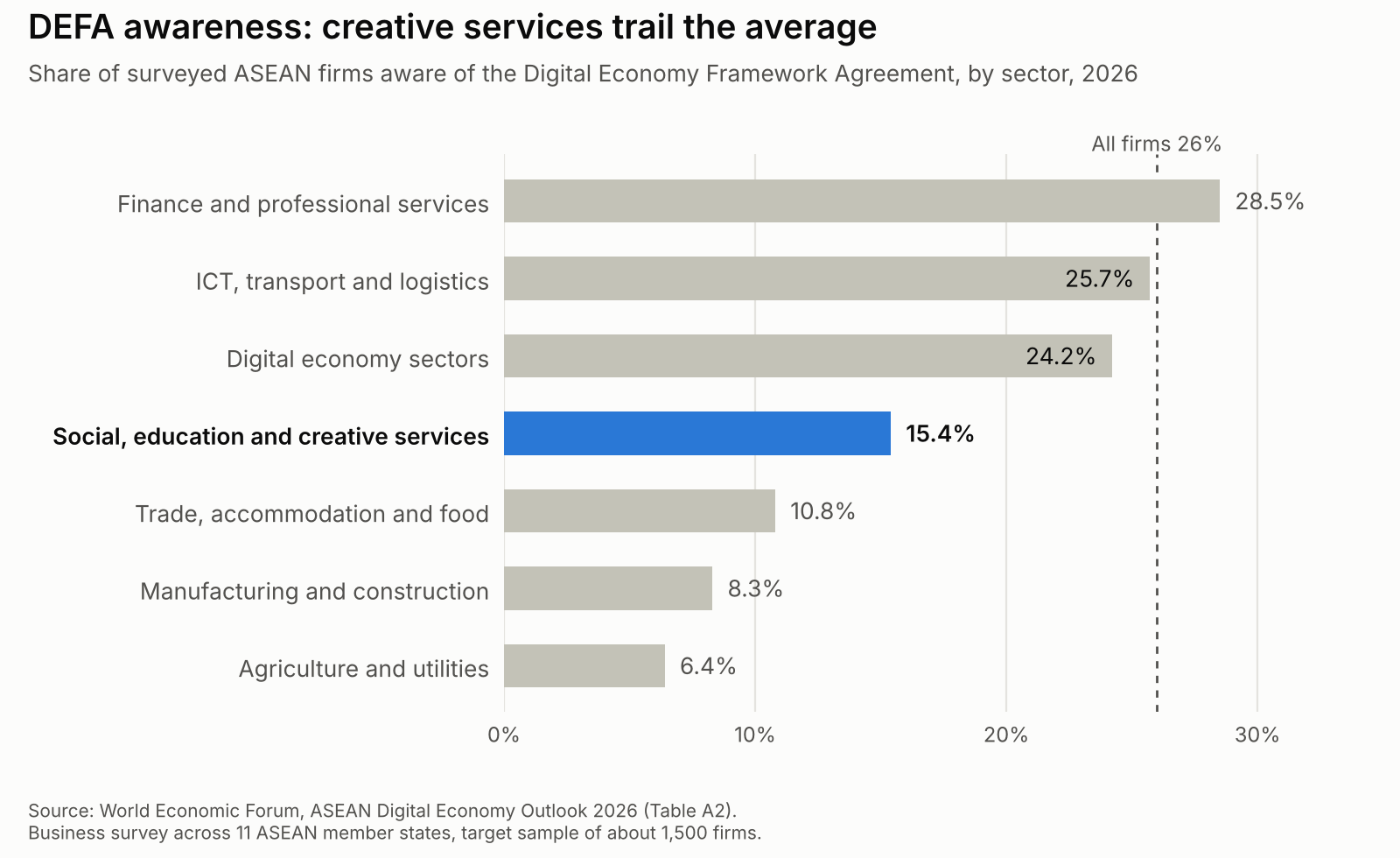
A World Economic Forum business survey across all eleven member states, designed to reach about 1,500 firms and published in September in the first ASEAN Digital Economy Outlook since DEFA was concluded, shows how far the agreement still is from most businesses. Only 26% of firms had heard of it: 23.8% of small and medium-sized firms, against 54.5% of large ones. Among firms in social, education and creative services, the figure was 15.4%.
Firms that did know DEFA ranked digital trade, online safety and payments as their priorities. Talent mobility came near the bottom, named among the top three by 8.2%. The pipes themselves are uneven, too. Just over half of adults in ASEAN, 53.6%, have made or received a digital payment, against 92.8% in a comparison group of Australia, China, Japan, Korea and the United States. On the OECD's index of restrictions on digital services trade, ASEAN averages 0.250 against 0.098 for the same group, and members range from 0.090 to 0.560.
Pipes before content
DEFA builds the pipes of a regional digital market: payments that connect, data that moves, transmissions that cross borders without duties. It does not decide what flows through them, or who earns from it.
That matters because of where the region starts. Southeast Asia, Singapore aside, exports creative goods at scale but sells few creative services, and much of the content its audiences stream is made elsewhere. A single digital market could help regional producers reach audiences next door, from Indonesian microdramas to Thai and Filipino music. It could equally make it cheaper for global platforms to serve the whole region from one hub.
Which of those happens depends less on DEFA than on what sits beside it: copyright and licensing systems, support for local production, and data on digital creative trade that most members do not yet collect. DEFA will also take time. Member states are still completing domestic procedures before signing, and the agreement is meant to accommodate economies at different stages of digital development, so its effects on creative markets will appear gradually.
Sources
- Statement of the Chairperson of the ASEAN SEOM on the conclusion of the ASEAN DEFA negotiations — ASEAN Secretariat, May 2026
- Keynote address at the 2026 DEFA Pre-Summit Forum — ASEAN Secretary-General Kao Kim Hourn, 7 September 2026
- DEFA: ASEAN to leap forward its digital economy and unlock US$2 trillion by 2030 — ASEAN Secretariat, 19 August 2023
- Study on the ASEAN Digital Economy Framework Agreement: public summary — prepared by Boston Consulting Group for ASEAN, October 2023
- ASEAN Digital Economy Outlook 2026 — World Economic Forum, September 2026, with a foreword by the ASEAN Secretary-General